Introduction
There is a study listed in the 'selected publications' section of each researcher I have been in contact with down in Roehampton: Dr Silas, Dr Levy and Dr Holmes. I figure examining a project all three contributed to could get me a really good insight into the department. The introduction of the paper begins by mentioning mirror neuron research that I gave an overview of in my last post (good start?). Specifically it references the hypothesis and proposals made by the big names in the area (e.g. Gallese, Rizzolatti, Lacoboni) that in order for an individual to experience empathy and understanding they would need direct-matching mirror neurons. If you will recall, this is the idea that when someone observes an action that matches their mental representation of said action, they understand the purpose of that action. In the last post I mentioned research which suggested humans have seperate brain areas for representing both purpose-of-action and the physical requirements of siad action. Though there is evidence for direct-matching, Silas, Levy and Holmes did not believe there was sufficient understanding of how such a system might actually function.
The researchers planned to examine the direct-matching hypothesis in more detail, using EEG measurements. EEG (or electroencephalography... bit of a mouthful) measures the voltage of the electrical signals created in neurons. It has a heck of a lot of medication diagnostic applications, but is fairly often used in research due to the lack of invasiveness and the relative accuracy with which it shows brain activity. It even makes participants look kinda cool.
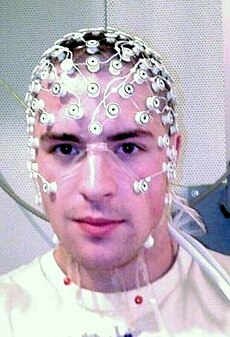 |
| One of the more minimalistic sets of EEG equipment. Helpfully provided by the wikipedia page. |
They would be studying two types of EEG measurement: Induced mu (frequencies between 8 and 13 Hz) desynchronisation and evoked readiness potentials. Now at this point I ahve absolutely no idea what either of those terms mean, so let's try and find a couple of definitions and examples... Evoked potentials are action potentials (nerve firing) that are recorded after participants are given some form of stimulus. Generally many suck trials are recorded so that the background 'noise' of other biological systems and the EEG equipment itself is cancelled out. Since the action potentials occur upon presentation of the stimulus (i.e. are time-locked), researchers can usually spot them amongst the randomly produced background distractors. This average signal rate is then analysed for "how frequently did the neurons fire during stimulus presentation?" giving an event related response (ERR). Induced mu desynchronisation measurements are based on the fact that 'mu' EEG frequencies decrease when body movement is imagined, observed or actually executed. When the ERR readings and random background noise are substracted from these measurement, one has the total increase or decrease in power of a task that cannot be explained by either of those variables. Man, this is a very difficult topic for those of us who have never used EEG equipment, but I think I have the gist of it.
Silas et al. mentions that in austistic individuals, little or no mu desynchronisation has been shown in autistic participants when compared to control groups (e.g. Ramachandran and Pineda, 2008). What this suggested was that autistic people may have malfunctioning direct-matching system, preventing them from understanding behaviours or developing empathy; two major features of autistic individuals. This viewpoint is termed the 'Broken mirror theory' in reference to mirror neurons. The causes and characteristics of autism are still a very controversial issue and this is certainly not an unargued theory, but it is what Silas et al. went on in this study. Autistic individuals have been found to have normal, higher, lower or no change in mu suppression than controls in a wide range of studies, leaving me with questions as to whether mu desynchronisation can reliably be used to measure mirror neuron activity. If it can, there are certainly other factors involved, but the broken mirror theory does not strive to accound for 100% of autistic symptoms.
Cheng et al. (2008) examined 20 males and 20 females for mirror neuron activity via mu-de measurements whilst they observed either hand movements or a moving dot. The hand movements were a mix of male-typicaly, female-typical and androgynous actions. Females, it was found, displayed significantly stronger mu suppression than male during the hand movements phase, but there was no real difference when watching the dot. The participants had been asked to fill out a survey intended to test empathy, called the "interpersonal reactivity index" before the main experiment (you can download and view the index here: http://www.suu.edu/faculty/barney/PSY3430/Factor%20Analysis%20Example/INTERPERSONAL%20REACTIVITY%20INDEX.doc ). This allowed the researchers to note that individuals who scored higher in empathy had increased mu suppression, whilst those who scored high in 'systemizing' on the opposite side of the spectrum had lower mu suppression. This view fit snugly with the extreme male brain hypothesis of autism, which suggests that the disorder is essentially an expression of exteme 'maleness'. Exaggerated versions of qualities males possess more typically than females. Wikipedia's introduction does a good job of explaining systemising:
" (defined as the drive to analyse or construct a system). A system in turn is defined as anything that follows rules, key classes of systems including mechanical systems, natural systems, abstract systems, and collectible systems. Rules in turn are defined as repeating, lawful patterns."
Systemising was negatively correlated (as systemising went up) with the degree of mu suppression (the degree went down). Not all measures of empathy were correlated in the alternative (or indeed any) direction with mu suppression, which would be expected in both broken mirror and extreme male brain theories. Research is all over the place in this area due to different methods used in each study. Puzzo et al. (2008) found no sex differences, but found the same correlation between systemising and suppression. They used the autism quotient survey to determine that those with higher scores did not display any significant suppression at, weirdly, beta frequencies rather than mu frequencies. This is all too hard to understand for a beginner in the scene! Time to simplify:
 |
| Yeah, I'm just certain empathy bear has tried learning about EEGs before. Bears go around doing that all the time. Git. |
In Silas et al's study, both induced and evoked measures of a known mirror neuron system were recorded whilst participants acted and observed simple tasks prompted by a tone. ERRs had been shown to more clearly display potential mirroring between action and observation more than mu suppression, and this was the first study to use them in the study of sex differences in this area. Additionally they asked participants to self report on topics of social cognition, The researchers aim was to test whether their EEG data would reflect the self reports of social cognition. Essentially this was an attempt to gain a better insight into sex and individual differences in direct-matching systems than the confused previous findings. If direct-matching and human social understanding / empathy are strongly linked, then there should be a strong covariance.
Methods
33 participants' data were used in the final analysis; 16 males and 17 females with a mean age of 25.7 years. They were seated individually in a dimly lit room in front of a computer monitor. Baseline mu states were recorded by having participants watch a 2d circle bounce around the monitor (giving the researchers readings for how the participants' mirror neurons reacted upon seeing non biological movement). For the main condition participants took part in both an executing and observation section. For execution, they were asked to fixate their eyes upon an LED sitting just above a button which they would need to press to give a response. If a high tone was given they would press the button on the right. A low tone meant the button on the left. For observation participants were again asked to fixate their eyes on the LED but were now sitting 45 degrees to the left of the experimenter who would be pressing the buttons similarly to in the execution phase. Three blocks of each type of trial were presented to each participant alternating between the two types. Each block consisted of 80 random high or low tones. In addition, participants completed the previously mentioned index, a systemising quotient and an empathy quotient. EEG data was taken for each participant in some currently unfathomable way, during testing. Some equally baffling form of electrical magic happened to make the data understandable, and there we have it. A results section! I really wish I had managed to find experience with an EEG before going to this meeting, but I doubt they'll expect that technical know-how from a novice.
Results... but mainly discussion of results since EEG data is a bit tricky at present
To begin with, check out this shiny image of a typical participant's EEG output:
 |
| One day I will learn all about EEG, come back to this post and explain it 100 times better than I currently have. |
Ok, the findings showed that participants' scores on the social cognitive scales were in the expected directions as defined by sex (this is, females scored higher on empathy and males scored higher on systemising). As expected females showed stronger mu suppression than males during observation, but mu suppression did not correlate consistently with scores on the social cognitive scales. This fits quite comfortably with the confused mess that is the collective findings of all previous research in the area. During execution there was no real sex difference in suppression. The data thus supports Cheng et al's findings that there is a reliable sex difference in mirror neuron response, with females showing a higher response rate. It does not, however, support the notion that social abilities are linked to mirror neuron abilities. It must be remembered however that the method used to determine varying levels of those abilities was self reporting; a method fraught with validity problems. Evoked response potentials did not correlate with self-reported measures of social cognitive abilities either. Nor did the ERPs show that females had more mirror neuron activity than males; the opposite was in fact true. The lack of consistency in result did not support a unified underlying system of mirror neuron response.
It has been suggested by previous researchs that induced measurements may reflect transmission of sensori-motor data, whilst evoked measurements might reflect 'readiness to respond'; two fundamentally different functions. There were sex differences in opposite directions for each type of mirroring (if there are indeed two types, this is now going into advanced level), and no reliable correlation between either of them and social abilities.
My tentative conclusion of the meat of this study, is that the very complicated subject of mirror neurons is entering into a stage where they are understood enough to provoke researchers to try to learn more, but not well understood enough for their implications of human behaviour to be pinpointed. I will find out what stage Silas, Holmes and Levy are at in developing further research into the phenomenon, and who knows perhaps I will be of help in the near future. I'm encouraged by the fact my interest is blossoming and that there are so many important questions yet to be answered about a thrilling subject. Many topics in psychology are so over-researched (the value of eye-witness testimony, for one) that I would struggle to think of a single study I could do to ehance world knowledge.
 |
This has been a struggle to read, I can only imagine. If you get this far thank you for sticking with it. If you have any questions please ask me so I can improve my understanding of the area by filling in some gaps in both our knowledge. Tomorrow I will focus on learning a little more about anxiety, emotion, language and the brain.

No comments:
Post a Comment