-----Contents-----
(Use CTRL-f for any of the terms in the contents to flick immediately to that section. E.g. CTRL-f "Trade")
Preface
1. Currency and The EU
2. Credibility
3. Jobs
4. Trade
5. Fiscal Position
6. Devolution
7. Security and Defence
8. Welfare and Public Services
9. Economy
10. The Greatness of Britain
11. Proportional Representation
12. List of Sources Used
12. List of Sources Used
-----Preface-----
With only a few days to go until the referendum on Scottish Independence, I wanted to stick my views out there and provide the results of my research via references to my sources. I want it to be clear that I am delighted that many individuals in Scotland and the UK have become energised with political discussion in a way I have never seen before. This includes me, as I have been apathetic towards UK politics since the last general election and its predictable results.
In the Scottish referendum every vote counts. This is radically different from elections using the first past the post (FTPT) system. Whether you vote yes or no, the intention behind this post is not to get in your face about it, and I hope that has been clear with my posts on Facebook and discussions in person. I simply value research before making decisions like this, and so have provided links to the sources from which I've built my decision upon. There are many hundreds of issues of impact in this decision, many of which have no clear solution and almost all of which involve an element of risk. I have not gotten close to covering them all.
Instead, I have taken an article linked to me by a good friend and researched no voter as a basis for structuring my own post. The article, called "The Tomkins Ten Points", is written by expert in constitutional law, Professor Adam Tomkins of the University of Glasgow. It is a summary of 12 articles he wrote for www.votenoborders.co.uk - a better together campaign website. The direct link to the post I'll be referring to throughout is:
I am not an expert in constitutional law like the author of the article I have decided to reference, but since my vote has equal value to his I have no problem in voicing my alternative perspectives. I consider myself a reasonably educated Scottish born - London based individual, and none of the sources I will reference here are behind pay walls. I have also used a mix of independent, pro-yes and pro-no sources to try and find a balanced argument when possible. In many cases I have selected a preferred argument based on what is important to me, but stated that I could understand an individual voting no if they had other concerns.
To reiterate: this post does not cover every issue that might be of interest. Hopefully the sources I provide can lead you to sites that may elaborate upon those not mentioned here. I hope you find this post informative in the run up to the referendum whatever you're voting.
Here's tae us! ~ James Munro
-----Currency and The EU-----
The SNP’s plans for
currency have obviously (to anyone observing any debate) been the most
hard-hitting point of the better together campaign. A lot of people are lined
up to vote no because of the uncertainty involved, and that’s probably fair
enough – they’re doing alright now and they don’t want the risk. I prefer not
to ignore the stance the SNP has taken, which has been supported by some
financial experts, such as professor of politics at the University of Edinburgh
and director of the economic and social research council programme Charlie
Jeffery
and Professor David Simpson who was chief economic adviser to Standard Life for
12 years
The SNP suggests that a currency union is an almost foregone conclusion since without it, the
rest of UK (rUK) would be damaged financially if they didn’t go for it. This
position is heavily argued against by the main political parties of Westminster
and by the royal treasury:
Tomkins claims that a currency union would lead to
‘unprecedented austerity’, that it would keep Scotland outside Europe for
longer and that it would force Scotland to have no control or influence over
the pound – leading to ‘volatile fiscal shock’ which is an excellent phrase. I
will use that in reference to my wallet whenever I spend a lot of money.
His claims are not directly supported by any figures or articles that he references in his own post, so it’s difficult to refute his points with counter figures. I think it is important to highlight that his claims are opinions and not facts, despite his expertise (I’m an expert in cognitive neuroscience – can claim what I like, doesn’t mean I know everything). SNP argues we’d get a currency union, every party in Westminster argues we wouldn’t, but of course they would. They don’t want us to leave, they would never agree to a union before the vote or the Yes campaign would get a massive boost. Independence organisation will take place over 1.5 years,
and these details will come to light during that period. Similarly, there have been no decisions made about Scotland’s entry into the EU at all. Different members of yes campaign, no campaign and the EU have stated different things. For example the professor of European law and human rights at Oxford University has suggested there will be a smooth entry into the EU for Scotland
whilst the former EU economics chief Olli Rehn noted that using the pound without a currency union would cause troubles for Scotland’s entry.
The European Policy Centre think tank argued that no EU member state would have a material interest in Scotland being outside the EU
but Spain and Belgium might veto and independent Scotland’s membership
His claims are not directly supported by any figures or articles that he references in his own post, so it’s difficult to refute his points with counter figures. I think it is important to highlight that his claims are opinions and not facts, despite his expertise (I’m an expert in cognitive neuroscience – can claim what I like, doesn’t mean I know everything). SNP argues we’d get a currency union, every party in Westminster argues we wouldn’t, but of course they would. They don’t want us to leave, they would never agree to a union before the vote or the Yes campaign would get a massive boost. Independence organisation will take place over 1.5 years,
and these details will come to light during that period. Similarly, there have been no decisions made about Scotland’s entry into the EU at all. Different members of yes campaign, no campaign and the EU have stated different things. For example the professor of European law and human rights at Oxford University has suggested there will be a smooth entry into the EU for Scotland
whilst the former EU economics chief Olli Rehn noted that using the pound without a currency union would cause troubles for Scotland’s entry.
The European Policy Centre think tank argued that no EU member state would have a material interest in Scotland being outside the EU
but Spain and Belgium might veto and independent Scotland’s membership
I agree the lack of
certainty might be a good reason to vote no, but one must remember that under
conservative party leadership UKIP has gained control in EU – A party who does
nothing for us there because they detest membership and are racist at an
organisational level.
27.49% of UK voters voted for UKIP (allegedly due to weariness at two party politics in Westminster). In scotland only 10.46% of voters went for UKIP with the SNP at 28.99% and Scottish Labour at 25.92% - A marked difference, where an independent Scotland would have some excellent and pro-european representation.
Plus there is enough lack of EU support south of the border for the conservatives to have been pushed into probably supporting a referendum even though that’d be against the desires of Scotland and probably the majority of UK individuals
Alex Salmond described a government being pressured into that position as a
humiliation for David Cameron, based on the embarrassment Cameron faced when
the head of the confederation of British Industry attacked his pledge to hold such a referendum
despite the clear damage a yes vote for leaving the EU would have on business.
A Scottish ‘No’ vote means Scotland will remain linked to a nation whose
leaders are anti-EU. A ‘Yes’ vote might make re-entry troublesome, but it is
voting for a parliament who follows the voice of Scotland who massively want to remain inside.
27.49% of UK voters voted for UKIP (allegedly due to weariness at two party politics in Westminster). In scotland only 10.46% of voters went for UKIP with the SNP at 28.99% and Scottish Labour at 25.92% - A marked difference, where an independent Scotland would have some excellent and pro-european representation.
Plus there is enough lack of EU support south of the border for the conservatives to have been pushed into probably supporting a referendum even though that’d be against the desires of Scotland and probably the majority of UK individuals
As for the volatile fiscal shock – again it’s based on the uncertainty that we’d get a currency union or not. A fair enough reason to vote ‘No’ if you place importance of currency above other positives of being independent.
-----Credibility-----
Using currency as the first point for a credibility argument deserves the same response: Nobody knows what the status of currency will be after the union – it doesn’t make the plans for independence incredulous. Independence movements are not without positives but obviously must involve careful organisation after a vote for a break-away. Claiming lack of credibility for the movement in comparison to the ‘Better Together’ campaign who releases arguments based on lazy voting and cheap emotional appeals is a tenuous position to hold.
(a.k.a. patronising BT lady - https://www.youtube.com/watch?v=OLAewTVmkAU
or You don’t love your family if you vote yes http://www.huffingtonpost.co.uk/2014/09/01/scottish-independence-better-together-campaign-posters_n_5746824.html)
Suggesting that the SNP
lied about EU membership is primarily based on the discovery that the SNP spent
£20,000 of taxpayer money to hide legal advice given to them about entry into
the EU. This advice turned out never to have existed, so the money was wasted.
This was revealed to the public in early October
along with alleged deceit from the SNP that there would be no problem with re-entry into the EU (might have missed something here). Entry into the EU hasn’t been proven a lie, and may not be until the actual decisions regarding EU membership are made (see the link about EU membership above for further reading). Despite the well-placed lampooning of the SNP on their waste of money, the author somehow ignores the direct and well-publicised lies that the Better Together campaign told a month or two ago, taking the voice of the new European commission president Jean-Claude Juncker discussing other member states as applying to Scotland too.
The retraction Jucker made, saying that his words in no way referred to Scotland, was not well publicised but revealed Better Together jumping to spread unease based on a misunderstanding. Both campaigns are trying to draw support for themselves based on EU arguments but no side has any facts regarding this, of course they don’t. The EU will not take a stand until after the vote. Individual members have suggested situations that can be interpreted either way.
along with alleged deceit from the SNP that there would be no problem with re-entry into the EU (might have missed something here). Entry into the EU hasn’t been proven a lie, and may not be until the actual decisions regarding EU membership are made (see the link about EU membership above for further reading). Despite the well-placed lampooning of the SNP on their waste of money, the author somehow ignores the direct and well-publicised lies that the Better Together campaign told a month or two ago, taking the voice of the new European commission president Jean-Claude Juncker discussing other member states as applying to Scotland too.
The retraction Jucker made, saying that his words in no way referred to Scotland, was not well publicised but revealed Better Together jumping to spread unease based on a misunderstanding. Both campaigns are trying to draw support for themselves based on EU arguments but no side has any facts regarding this, of course they don’t. The EU will not take a stand until after the vote. Individual members have suggested situations that can be interpreted either way.
Tomkins states that
Scotland could not have a radically different immigration policy and that the
SNP claim that Scotland will remain in the common travel area with rUK and
Ireland. In fact, there is nothing to stop Scotland developing a new
immigration policy – including the joining of the Shengen area of mutual travel
without need for border or passport control with 26 other European countries of
which UK is currently not included. The SNP and other yes campaigners wish for
extra-but-controlled immigration for Scotland due to Scottish organisations
such as universities becoming critical of current UK policy. Universities in
Scotland dislike the difficulties they suffer with student visa which harm
their ability to recruit minds from around the world.
Personal relationships can also be broken up due to laws that the SNP desires to change.
The Yes Campaign have no intention of joining the Shengen agreement but is always a possibility.
Personal relationships can also be broken up due to laws that the SNP desires to change.
The Yes Campaign have no intention of joining the Shengen agreement but is always a possibility.
What Tomkins refers to is the desire of rUK to avoid having the problems that
a different immigration attitude would cause for them. Fair enough, they don’t
want border hoppers to come to a more inclusive Scotland only to make their way
south to bother England and cause problems during a period of anti-extremism
politics. The BT campaign thus suggests they would be forced to apply border
control at the Scottish border
The SNP disagrees.
Border control would be a slap in the face for industry and cultural relations on both sides, so who knows how this would go. Scotland wants more immigration, England wants less and so we currently get less. I see independence as a positive in this light.
Finally the author suggests that the yes campaign (which is not the same as the SNP, the author really needs to sort this out or else the Greens will be up his arse for a start :P) will claim a right to public institutions of the UK, despite this being against the law. What public institutions are the SNP claiming rights to, and what laws prevent them from doing so? The author is repeatedly making scary assertions without referencing anything, least not the fact he doesn’t know the answers because nobody does until it is agreed in the period leading up to a declaration of independence (not on the day of a Yes vote outcome). This is scaremongering, and both sides have been party to it but I disagree with it as a tactic.
In summary, his arguments for a lack of credibility ignore the comparatively embarrassing and negative position of the BT campaign (in my opinion – obviously) and focus on claims that he states as fact but which are, indeed, opinion in every case. His argument is not an argument which works for me, personally. This is the same for Scaremongering yes campaigners.
-----Jobs-----
The SNP disagrees.
Border control would be a slap in the face for industry and cultural relations on both sides, so who knows how this would go. Scotland wants more immigration, England wants less and so we currently get less. I see independence as a positive in this light.
Finally the author suggests that the yes campaign (which is not the same as the SNP, the author really needs to sort this out or else the Greens will be up his arse for a start :P) will claim a right to public institutions of the UK, despite this being against the law. What public institutions are the SNP claiming rights to, and what laws prevent them from doing so? The author is repeatedly making scary assertions without referencing anything, least not the fact he doesn’t know the answers because nobody does until it is agreed in the period leading up to a declaration of independence (not on the day of a Yes vote outcome). This is scaremongering, and both sides have been party to it but I disagree with it as a tactic.
In summary, his arguments for a lack of credibility ignore the comparatively embarrassing and negative position of the BT campaign (in my opinion – obviously) and focus on claims that he states as fact but which are, indeed, opinion in every case. His argument is not an argument which works for me, personally. This is the same for Scaremongering yes campaigners.
-----Jobs-----
The author states
360,000 jobs in Scotland created by rUK companies and 290,000 jobs depending on
exports for the UK – 1/10 of Scottish jobs. In addition, 200,000 jobs in
Scotland depend on the financial services industry (no references to back this
up. ARGH! Don’t just state things and have people take you at your word. He’s
an academic professor, even if he’s right he should know better). He goes on to
state that 80% of these people in the financial industry have their pensions
and mortgages sold to customers in the rUK. Not sure what he means by that,
they sell their pensions and their mortgages to rUK customers? Does he mean the
companies do…? My ignorance is evident here.
He said independence would jeopardise many of the above jobs. How, why? Many of the companies that make up his figures have stood out in support of independence (and many against!) How exactly would their jobs suffer? If you state things like this on the vague argument of “Something will change, so their jobs will chance” without any real explanation for how, then you have little credibility yourself, I believe. I am unconvinced of this argument from lack of facts and the face hundreds of businesses have officially supported independence so it’s unlikely to be a disaster scenario where everyone will suffer. Alex Salmond in November 2013 claimed that independence would reate a jobs boom
as outlined in the 200 page paper on the Scottish and UK economy released before the White Paper.
More recently in August this year, Scottish Finance Secretary John Swinny unveiled the Scottish government’s ten point plan for creating jobs.
The pro-union response to these ten points was that it meant nothing until the currency question could be sorted out; which is a massive cop-out in my opinion. Alex Salmond has repeatedly challenged the BT campaign to explain how their plans for a no vote would result in more jobs for Scotland.
He said independence would jeopardise many of the above jobs. How, why? Many of the companies that make up his figures have stood out in support of independence (and many against!) How exactly would their jobs suffer? If you state things like this on the vague argument of “Something will change, so their jobs will chance” without any real explanation for how, then you have little credibility yourself, I believe. I am unconvinced of this argument from lack of facts and the face hundreds of businesses have officially supported independence so it’s unlikely to be a disaster scenario where everyone will suffer. Alex Salmond in November 2013 claimed that independence would reate a jobs boom
as outlined in the 200 page paper on the Scottish and UK economy released before the White Paper.
More recently in August this year, Scottish Finance Secretary John Swinny unveiled the Scottish government’s ten point plan for creating jobs.
The pro-union response to these ten points was that it meant nothing until the currency question could be sorted out; which is a massive cop-out in my opinion. Alex Salmond has repeatedly challenged the BT campaign to explain how their plans for a no vote would result in more jobs for Scotland.
The author’s argument for the Faslane naval base closure is better. It wont close, but there may be radically reduced employment there as a conventional naval base. The conversion to a conventional naval base will create jobs but others will be destroyed.
This may be likely to bugger Faslane and surrounding villages as that’s their main income. Doubt you’d get many yes voters there. But this is a tough argument because clearly Scotland is anti-nuclear as a whole. The yes campaign aren’t just throwing away jobs willy-nilly in the case of Faslane, they’re following the majority voice of the Scottish public who don’t want a major nuclear target a few miles from the majority of their population.
-----Trade-----
Scotland’s trade with
the rUK is worth 4 times as much as her trade with the rest of the world,
claims the author (without reference!) He states some other values including
that Scotland’s trade with the UK is 4 times higher than her trade with the EU
– which seems conflicting with the first statement just mathematically. He
believes that turning Scotland’s border into an ‘international frontier’ would
diminish Scottish trade. The author might be referencing some of the details
also referred to in this article:
in which the positives and negatives of independence on UK trade are discussed. It is almost certain that he did, as the same article mentioned Canada and America which the author then goes on to discuss. The author is overwhelmingly negative about the impact of indepence on trade, whilst an Economic and Social Research Council study referenced by the BBC article suggests that switching to a trade situation similar to Ireland and the UK would only reduce annual trade by about 0.1%
whilst trade may be boosted with the rest of the world.
in which the positives and negatives of independence on UK trade are discussed. It is almost certain that he did, as the same article mentioned Canada and America which the author then goes on to discuss. The author is overwhelmingly negative about the impact of indepence on trade, whilst an Economic and Social Research Council study referenced by the BBC article suggests that switching to a trade situation similar to Ireland and the UK would only reduce annual trade by about 0.1%
whilst trade may be boosted with the rest of the world.
Sure, IF Scotland’s
border becomes an international frontier on the same basis as current UK and
the rest of the world, it might. ‘IF’ that happens – and it is not even close
to being decided that it will happen despite the author’s certainty. More
scaremongering on his part I feel. What he doesn’t mention is that Scotland’s
pro-european and immigration stance makes it more likely that an independent
Scotland may (attempt to) join larger international bodies that reduce the obstruction
of borders on a much larger scale than with rUK
The author compares
Scotland’s potential situation to Canada because they have a relatively open
border with the US and yet have 20 times as much trade within Canadian
provinces than with the US. This is a dreadful example to choose as it
discusses two countries of much greater size and which developed as separate
counties. Why not compare Scotland’s trade with that of Norway which trades
similar commodities and resources from an advantageous position in the European
Economic Community, or other countries within Europe that have split such as the
Czech Republic and Slovakia. In their situation there was a sharp decrease in
trade but compensated with increased trade with other neighbours. They split on
much less beneficial terms as would Scotland and the rUK, and in today’s modern
economy and with reference to Ireland and the UK, things may be much more
positive than with Slovakia and Czech Republic. The author fails to convince me
with his cherry-picked comparisons and claims that Scotland’s trade is doomed
despite more reasonable voices claiming the story is more mixed.
-----Fiscal Position-----
The author claims that domestic tax revenues are lower for Scotland than for the rest of the UK and yet public spending is higher per head in Scotland than it is in the rest of the UK. Yes, public spending is higher per person in Scotland than rUK but we pay for it all according to the Financial Times.
So to clarify, £1200 more is spent on each Scottish person than the average UK person, but Scotland contributes £1700 more per person than the average UK person in taxes according to the national statistics publication, government expenditure and revenue Scotland.
When gas and oil are taken into account, each Scottish taxpayer only gets 70% of the taxes paid back into Scotland. This whole position is one of the most argued point in the entire debate. It depends how you look at it. It is often claimed that Scotland gets more money spent on it than it generates in tax. This was the case in 2011-12 where Scotland generated £57 billion and got £64.5 billion spend on it in return. The pro-independence work “The Wee Blue Book”, however, points out that this money is not generated from tax money in the rest of the UK. It is borrowed from international banks and spent on projects such as Trident, the Olympics held in London and the HS2 railway
Scottish taxpayers need to pay those loans back, even if they made no use of the things they were spent on. Wales has suffered a similar fate, with both constituent countries of the UK paying billions of pounds for the HS2 from London to Birmingham because Westminster argues it benefits the entire UK.
-----Fiscal Position-----
The author claims that domestic tax revenues are lower for Scotland than for the rest of the UK and yet public spending is higher per head in Scotland than it is in the rest of the UK. Yes, public spending is higher per person in Scotland than rUK but we pay for it all according to the Financial Times.
(http://archive.today/vcQ78 - “The cost
[of public spending] to the treasury is more than outweighed by oil and gas
revenues from Scottish waters.”)
So to clarify, £1200 more is spent on each Scottish person than the average UK person, but Scotland contributes £1700 more per person than the average UK person in taxes according to the national statistics publication, government expenditure and revenue Scotland.
When gas and oil are taken into account, each Scottish taxpayer only gets 70% of the taxes paid back into Scotland. This whole position is one of the most argued point in the entire debate. It depends how you look at it. It is often claimed that Scotland gets more money spent on it than it generates in tax. This was the case in 2011-12 where Scotland generated £57 billion and got £64.5 billion spend on it in return. The pro-independence work “The Wee Blue Book”, however, points out that this money is not generated from tax money in the rest of the UK. It is borrowed from international banks and spent on projects such as Trident, the Olympics held in London and the HS2 railway
Scottish taxpayers need to pay those loans back, even if they made no use of the things they were spent on. Wales has suffered a similar fate, with both constituent countries of the UK paying billions of pounds for the HS2 from London to Birmingham because Westminster argues it benefits the entire UK.
The author of the
linked article fails to identify the amount of money Scotland takes on as
belonging to the UK. Scotland’s deficit (difference between money receive in
taxes and the amount of money it spends) £7.6 billion between 2011-12 according
to Alistair Darling
Scotland, however, had to repay £10.6 billion pounds as part of the union, meaning it took on £3 billion extra debt, which is more than three times the cost of Scotland’s free University tuition, free prescriptions, free bus passes for pensioners and free personal care for the elderly combined.
Tomkins then points out that without the strength and security of the rUK, Scotland would no longer be able to fund its deficit. Firstly, according to the points raised above, that is a ridiculous position. Secondly, the options that the author outlines to fix this deficit are the method devised by the BT campaign to make the options sound realistic whilst simultaneously impossible. E.g. cutting public spending by £2.5 billion pounds or increasing taxation by the same amount. None of this would be remotely necessary according to Yes campaigners who have devised that Scotland would actually be much better off as a result of leaving the union.
Scotland, however, had to repay £10.6 billion pounds as part of the union, meaning it took on £3 billion extra debt, which is more than three times the cost of Scotland’s free University tuition, free prescriptions, free bus passes for pensioners and free personal care for the elderly combined.
Tomkins then points out that without the strength and security of the rUK, Scotland would no longer be able to fund its deficit. Firstly, according to the points raised above, that is a ridiculous position. Secondly, the options that the author outlines to fix this deficit are the method devised by the BT campaign to make the options sound realistic whilst simultaneously impossible. E.g. cutting public spending by £2.5 billion pounds or increasing taxation by the same amount. None of this would be remotely necessary according to Yes campaigners who have devised that Scotland would actually be much better off as a result of leaving the union.
I would suggest readers
retrace the financial decisions made by Osborne and Darling in the past decade
before coming to the conclusion that Scotland will be unable to handle its
deficit without the UK’s ‘strength and security’. is anything but a magic
phrase that is as shallow as it is fancy-sounding. The author manages to miss,
for example, any discussion of oil revenue and its squandering at the hands of
Westminster (only Iran and the UK have failed to set-up an Oil fund out of all
the countries which have struck the liquid gold. Norway, in 24 years, has saved
£500 billion as a result of oil from the same sea.
Don’t forget right wing policy developing a position of welfare where nominal attempts to reduce abuse of the system put individuals in a humiliating state of abused near-poverty,
dealing with the banks as if they did a good job in the credit crunch and not holding them to account
selling the post-office in such a manner where the country received a pittance of money but interested rich parties gained tremendous amounts as a result.
Don’t forget right wing policy developing a position of welfare where nominal attempts to reduce abuse of the system put individuals in a humiliating state of abused near-poverty,
(http://www.bbc.co.uk/news/uk-politics-25617844
and http://rt.com/uk/170600-uk-benefits-legislation-rights/)
dealing with the banks as if they did a good job in the credit crunch and not holding them to account
selling the post-office in such a manner where the country received a pittance of money but interested rich parties gained tremendous amounts as a result.
Despite these negatives,
the UK is currently seeing the most growth of its economy since 2008 and is
doing better than most other EU countries.
So you have to take the good with the bad. Voting ‘Yes’ is a risk made for a better, fairer, more responsible and probably much more valuable system of monetary management. Voting ‘No’ is sticking with the status quo of what I described above. Fair enough either way, just depends on your perspective.
-----Devolution-----
So you have to take the good with the bad. Voting ‘Yes’ is a risk made for a better, fairer, more responsible and probably much more valuable system of monetary management. Voting ‘No’ is sticking with the status quo of what I described above. Fair enough either way, just depends on your perspective.
-----Devolution-----
Devolution has been
popular and successful, says the author. I absolutely agree and it would be
hard to find anyone who doesn’t. Indeed, the Yes campaign tried to get a
devo-max option added to the ballot for the referendum but the BT campaign
rejected this and forced it to be a Yes/No question for complete independence.
A position they are now clearly regretting as the polls draw incredibly close, as judged by their panicked promise for more powers for Scotland days often hundreds of thousands of postal voters have already cast their votes.
and
So Tomkin's ideal solution of giving Scots more devolved powers whilst maintaining the union is great and many people would prefer it over a yes or no vote, but it was removed from being an option by the conservatives, who previously stood in the way of devolution in Thatcher’s era
(to the probably undeniable detriment of Scotland - http://pbs.twimg.com/media/Bw9GQTDIIAEGy52.jpg)
If we vote ‘no’ we have zero voting power in Westminster to make either labour or the tory party push for the powers they are promising us now. Don’t agree with me? Scotland has not had more than 1 Tory MP since 1992 and has never voted a for the conservative party in a majority since 1959. Despite this the Tories have achieved a leadership position for 38 years out of the past 54. Similarly, if the entire Scottish electorate was prevented from voting, Labour would have only lost its control of Westminster twice.
Neither party needs to push for votes in Scotland as a result, nor will either party willingly cross the rest of the united kingdom to give us powers which they don’t have.
or
or
or
In short, voting ‘No’ comes with a real and potent risk of Scotland being given fuck all, whilst voting ‘Yes’ comes with risks but will guarantee a few very exceptional things. I will outline these at the end of this essay. This is crucial to understand.
The author states that all three Westminster parties of any consequence have ‘pledged’ to enhance devolution further if we vote no. Just like the lib dems pledged not to increase student fees in England. Just like labour and the conservative pledged to oppose privatisation of the NHS in England and Wales.
I don’t trust their pledges for devo max and I am not sure why anyone else does given their histories. Especially when they removed devo max from being an option in the referendum in the first place.
A position they are now clearly regretting as the polls draw incredibly close, as judged by their panicked promise for more powers for Scotland days often hundreds of thousands of postal voters have already cast their votes.
and
So Tomkin's ideal solution of giving Scots more devolved powers whilst maintaining the union is great and many people would prefer it over a yes or no vote, but it was removed from being an option by the conservatives, who previously stood in the way of devolution in Thatcher’s era
(to the probably undeniable detriment of Scotland - http://pbs.twimg.com/media/Bw9GQTDIIAEGy52.jpg)
If we vote ‘no’ we have zero voting power in Westminster to make either labour or the tory party push for the powers they are promising us now. Don’t agree with me? Scotland has not had more than 1 Tory MP since 1992 and has never voted a for the conservative party in a majority since 1959. Despite this the Tories have achieved a leadership position for 38 years out of the past 54. Similarly, if the entire Scottish electorate was prevented from voting, Labour would have only lost its control of Westminster twice.
Neither party needs to push for votes in Scotland as a result, nor will either party willingly cross the rest of the united kingdom to give us powers which they don’t have.
or
or
or
In short, voting ‘No’ comes with a real and potent risk of Scotland being given fuck all, whilst voting ‘Yes’ comes with risks but will guarantee a few very exceptional things. I will outline these at the end of this essay. This is crucial to understand.
The author states that all three Westminster parties of any consequence have ‘pledged’ to enhance devolution further if we vote no. Just like the lib dems pledged not to increase student fees in England. Just like labour and the conservative pledged to oppose privatisation of the NHS in England and Wales.
I don’t trust their pledges for devo max and I am not sure why anyone else does given their histories. Especially when they removed devo max from being an option in the referendum in the first place.
In short, I disagree
wholeheartedly with the author’s position that ‘No vote preserves and enhances
devolution’ whilst ‘a Yes vote would mean an end to it’. It depends entirely on
the benevolence of a government which has repeatedly shown none. There are
countless articles demonstrating that Westminster will not put Scotland first
without great ramifications from a rUK public which often resents Scotland’s
devolution as linked in the articles above.
-----Security and Defence-----
-----Security and Defence-----
The UK is one of the
safest places in the world to live. The author rightly suggests this is not
automatic and comes at the price of the impressive technological lead we have
over many countries worldwide in terms of military and other security
organisations. This includes intelligence operations, which we share with US,
Canada, Australia and New Zealand according to the author (I know nothing about
this, and no references given to look at, so taking his word on this). He
claims Scotland would not be able to join this network. Why? Many articles
suggest talks are underway, not just being dsmissed
The author just claims this with no explanation. He goes on to state that the UK has the 4th biggest defence budget in the world, and the Scots contribute less than 1/10th of the money for this (Scotland makes up less than 10% of the UK, so what’s his point? – that seems reasonable to me).
The author just claims this with no explanation. He goes on to state that the UK has the 4th biggest defence budget in the world, and the Scots contribute less than 1/10th of the money for this (Scotland makes up less than 10% of the UK, so what’s his point? – that seems reasonable to me).
His point in this
section is to point out that if Scotland were to leave, they would have no
access to the defence, intelligence, or diplomatic staff of 14,000 individuals
across 150 countries and territories worldwide.
This is something I know very little about so don’t want to pull an
argument out of my arse. Instead I shall refer to the arguments made by members
of the Yes campaign and general anti-war demonstrators who claim that the vast
defence budget might not be the best argument to make given Scotland’s repeated
peaceful stances
Though Scotland has supported numerous modern wars,
they have also rejected UK involvement in others.
Though Scotland has supported numerous modern wars,
they have also rejected UK involvement in others.
This might be a
compelling reason to vote no, but again it seems uncertain whether Scotland
will continue to be able to share UK diplomatic offices and resources after
independence. If anyone can provide sources of more information on this I’d be
grateful.
-----Welfare and Public Services-----
-----Welfare and Public Services-----
Public spending is higher
in Scotland because Scotland decides more should be spent on the public. The
author mentions that security payments and pensions are supported by the UK
taxpayers – but similarly Scotland contributes to the security and pensions of
other UK citizens. This would change as a result of independence to Scotland
supporting its own security payments and pensions – and since Scotland has a
very left-wing perspective on public spending, these are likely to be well
supported.
Research funding for
Scottish universities is a scary issue for me in particular – living as a
researcher and potentially getting involved with that world more often in
future. Scotland has a strong reputation for research worldwide and
historically so a reduction in research funding would be horrible. The author
states that Scotland is 8% of the UK’s population but got 13% of research
funding allocation from the UK research council. This is an odd bit of
information to give and somewhat misleading, as the general public of Scotland
are not all researchers and are not the exclusive beneficiaries of Scottish
research money. The author does point out that £6 billion is contributed to the
Scottish economy from our universities and employ 39,000 people (God sake men,
reference your work. Digging for your sources is a real time-waster and you
know it). The Telegraph, in July 2013, identified that Scottish universities
would face £10 billion in cuts as a result of independence. This was based on
the pension scheme given to university staff which is currently implementing a
ten year extension to pay back the deficit they owe. Unfortunately due to EU
regulations on pensions (http://www.freshfields.com/uploadedFiles/SiteWide/Knowledge/32199.pdf),
the extension would no longer be valid if a border was placed between rUK and
Scotland and so Scotland would immediately have to pay the £10 billion portion
of their deficit. The SNP, however, argued that this would not be the case as
the EU had previously agreed on a special deal for such deficits between the UK
and Ireland, and Scotland would thus be likely to achieve the same deal
Still scary, you can see.
Still scary, you can see.
The author additionally
adds that the BBC broadcasts £4 billion worth of… broadcasts(?) per year(?)
despite only £320 million worth of license fees coming from Scotland. Yes, and
only one third of that portion of the license fee is spent on BBC Scotland.
With an independent broadcasting service based on the same license fee payments
(in theory), triple the amount of money could be spent on a national media
service. Bear in mind that commercial media would not be impacted by
independence. A 2012 report into Irish spending suggested that they spent £20
million for the rights to broadcast all
overseas programming (http://static.rasset.ie/documents/about/2012-english-annual-report-for-the-web.pdf).
Even if BBC took up the majority of that, Scotland could pay for the same
rights and have a much stronger national media centre comfortably. The author
fails to examine this point adequately in my opinion and just sticks it out
there within his argument on public service issues to convince people based on
a probably false view of TV being crushed for Scottish viewers.
200 additional UK
public services work for Scotland and the author notes that the SNP have yet to
explain how the public would pay for replacements to these services upon
independence. He doesn’t give examples of these services other than those I
have already addressed. So yes, public services may take a hit, but given that
the SNP have advocated increased spending in this regard, they might also see a
boost.
I didn’t know much
about how welfare and public services are supposed to be dealt with, so did
some research. Pensions are of massive importance to Scottish folk and it’s
been a primary target of BT campaigning to focus on the uncertainty. It is
argued by Yes campaigners, however, that the position on pensions is one of the
few that can be handled with certainty however. This (yes-friendly) resource
describes it in detail:
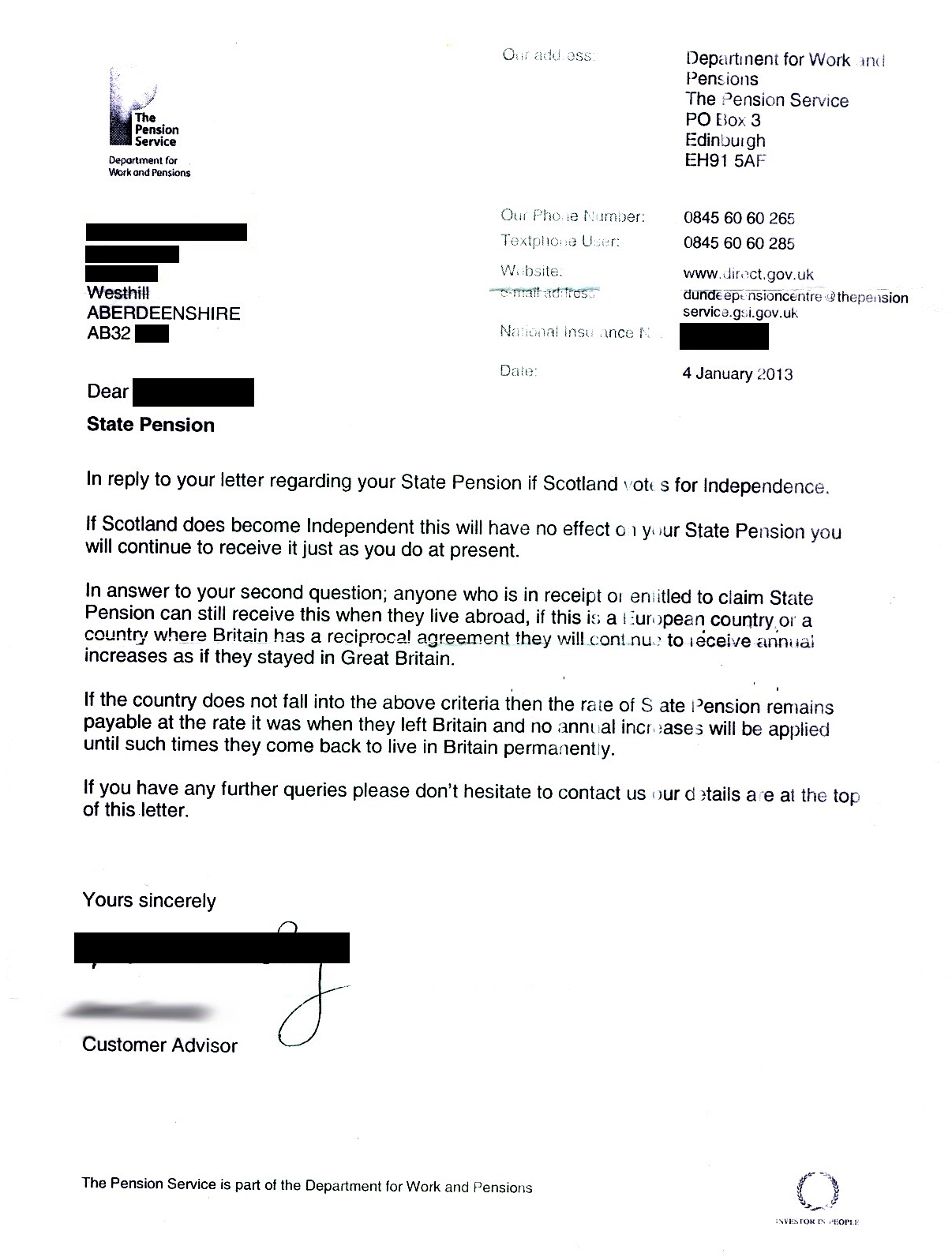
To summarise: Ian Davidson, a Labour MP and head of the Scottish Affairs Select Committee affirmed with those in control of such things in Westminster, that independence will not adversely affect the state pension of any individual in Scotland. Any increase in state pension would have to be paid for by Scotland, fairly enough.
He was affirming the statement made by Steve Webb (UK government minister for pensions) in the Scotsman on the same day.
The department for work and pensions made this clear in 2013 in a reply to a query regarding pensions.
To summarise: Ian Davidson, a Labour MP and head of the Scottish Affairs Select Committee affirmed with those in control of such things in Westminster, that independence will not adversely affect the state pension of any individual in Scotland. Any increase in state pension would have to be paid for by Scotland, fairly enough.
He was affirming the statement made by Steve Webb (UK government minister for pensions) in the Scotsman on the same day.
The department for work and pensions made this clear in 2013 in a reply to a query regarding pensions.
Public sector pensions
are also safe according to the neutral ‘Prospect’ trade union. The pensions
officer for the union noted in a teleconference call between union members on
May 2014; that if “you are a member of a public service pension scheme that’s
delivered by a Scottish administration… then literally I can’t imagine what
would be very different under independence because you’re already having your
occupational pension delivered by a Scottish administrator”
He further noted that the individual would not experience any change and the specifics would be agreed upon between governments (this includes the armed services and civil service).
(http://worldofstuart.excellentcontent.com/ProspectUnionPensions.mp3
- admittedly this would be a pain in the arse to listen to the whole way
through)
He further noted that the individual would not experience any change and the specifics would be agreed upon between governments (this includes the armed services and civil service).
Private pensions are,
however, uncertain. There seem to be multiple ways for organisations to handle
these, such as setting up separate Scottish and rUK schemes. Certain EU funding
regulations must be dealt with here, though successful arrangements have been
made on a number of occasions such as between the UK and Ireland
The PDF linked here describes EU rules regarding cross-borders pensions schemes, something which could be avoided with separate schemes within different components of the EU. Gives you some idea of examples regarding different scenarios, too. Point being, private pensions are uncertain, but not screwed (pensions givers must continue to compete, why would independence change that?) David Davidson, a pensions specialist at Spence & Partners pointed out that EU laws on cross-borders private pensions could scupper many UK charities
but this is not taking into account alternative solutions or extensions that EU laws allow.
The PDF linked here describes EU rules regarding cross-borders pensions schemes, something which could be avoided with separate schemes within different components of the EU. Gives you some idea of examples regarding different scenarios, too. Point being, private pensions are uncertain, but not screwed (pensions givers must continue to compete, why would independence change that?) David Davidson, a pensions specialist at Spence & Partners pointed out that EU laws on cross-borders private pensions could scupper many UK charities
but this is not taking into account alternative solutions or extensions that EU laws allow.
Those who have been
building and receiving pensions in the past 2 decades are unlikely to sing
praises of Westminster’s handling of pension money, however. Gordon Brown
‘raided’ the pensions of people at the time by scrapping tax relief on pension
company’s dividends, costing a total of £118 billion for people’s pensions
since he did it in 1997.
Westminster is also planning to increase the age of receipt of a state pension to 70, after some individuals have already lived through the age of pension receipt increasing by 5 years – these changes have been put in place by labour and conservative governments.
At the national pensioners convention in June 2013, a 2 year report was summarised by a very negative attitude to the way pensions had been handled, including the recommendation that: “The state pension age for men and women should be maintained at 65 from 2020 without any automatic linking of the state pension age to life expectancy”.
(http://archive.today/Snskt
- a 2014 article in the Mail Online who noted that the coalition government has
yet to do anything about it)
Westminster is also planning to increase the age of receipt of a state pension to 70, after some individuals have already lived through the age of pension receipt increasing by 5 years – these changes have been put in place by labour and conservative governments.
(e.g. http://www.moneyobserver.com/news/13-05-2013/what-state-pension-changes-mean-older-women;
http://www.theguardian.com/uk-news/2013/dec/05/state-pension-age-raised-to-70-autumn-statement)
At the national pensioners convention in June 2013, a 2 year report was summarised by a very negative attitude to the way pensions had been handled, including the recommendation that: “The state pension age for men and women should be maintained at 65 from 2020 without any automatic linking of the state pension age to life expectancy”.
(http://npcuk.org/wp-content/uploads/2013/06/A-Decent-State-Pension-for-All-Generations.pdf
– There’s a LOT of stuff in here, essentially describing the current state of
pensions as a miserable affair including: “The UK was ranked
fourth from bottom out of 27 European countries, with more than one in five
(21.4 %) of older British people classed as being at risk of poverty in 2010;
significantly higher than the EU average of 15.9%”).
In short, suggesting
that a No vote means good things for pensions as a certainty is not supported
to the point where it can be used as a strong argument, it seems. The argument
from the BT campaign is based off of the notion that we could “club together”
to support each other. This is an inspiring notion but is not supported by the
current and historical evidence of treatment of pensions by Westminster. The BT
campaign does a good job of noting figures from a report by the institute of
fiscal studies (IFS - http://www.ifs.org.uk/bns/bn139.pdf) which determined
that Scotland gets more spending on benefits then the UK average by 2%. It also
noted that of that benefit funding, 1% more went towards pensions in Scotland
than the UK as a whole. This report was published in July 2013 and is still
current on the BT website so presumably the facts remain straight. The IFS
suggests that Scotland simply couldn’t keep up with their promised more
generous benefits scheme.
Indeed it seems the BT
campaign position is not so much that pensions would be in danger, but that the
SNP plans to give more generous pensions is troublesome. For example the
HeraldScotland reports on a statement by Scottish Labour that suggests the
SNP-planned rises to pensions would cost the country £700 million that they
haven’t got.
I want to use a
facebook statement put up by Jon Jeffres fron Dunblane to summarise my concerns
with the BT campaign using pensions to gain votes. Jeffres’ post on the BT fb page
shows that he is voting ‘No’ because he doesn’t want insecurity in his pensions.
As described with references in this post of mine, his state pension is secure as it stands according to both Holyrood and Westminster, and it is clear that pensions in the current UK government are there to be played with at need. Jeffres is worried that having less young people to support the pensions for an aging population will have an adverse effect on Scotland’s pensioners. He also likes the idea of tax being paid by “a worker in Liverpool [supporting] a pensioner in Leith and vice versa.” – A statement almost directly copied from the BT campaign website page about pensions “When you retire in Lanark your pension is paid by the taxes of a young person in Liverpool”
Jeffres then moves on to talk about cultural bonds being broken and then repeats his concerns about the currency. Leaving governance of Westminster does not necessitate the breaking of cultural bonds, and the currency is another matter entirely (which in itself is co uncertain that I can understand a ‘No’ vote as a result). An ageing population across a bigger country will be hit in the same way as an aging population in a smaller country, as far as I can see. Maybe I’m wrong here, though. His argument, overall, is essentially a copy paste from the BT campaign website so sounds like he’s just been told what to say. I really hope that isn’t the case, as just a little bit of research has shown his main concerns about pension are not founded in fact!
As described with references in this post of mine, his state pension is secure as it stands according to both Holyrood and Westminster, and it is clear that pensions in the current UK government are there to be played with at need. Jeffres is worried that having less young people to support the pensions for an aging population will have an adverse effect on Scotland’s pensioners. He also likes the idea of tax being paid by “a worker in Liverpool [supporting] a pensioner in Leith and vice versa.” – A statement almost directly copied from the BT campaign website page about pensions “When you retire in Lanark your pension is paid by the taxes of a young person in Liverpool”
Jeffres then moves on to talk about cultural bonds being broken and then repeats his concerns about the currency. Leaving governance of Westminster does not necessitate the breaking of cultural bonds, and the currency is another matter entirely (which in itself is co uncertain that I can understand a ‘No’ vote as a result). An ageing population across a bigger country will be hit in the same way as an aging population in a smaller country, as far as I can see. Maybe I’m wrong here, though. His argument, overall, is essentially a copy paste from the BT campaign website so sounds like he’s just been told what to say. I really hope that isn’t the case, as just a little bit of research has shown his main concerns about pension are not founded in fact!
Researching public
spending is a minefield, in contrast to pensions. Every newspaper is heavily
biased one way or another. For instance the Telegraph is famously pro-union and
uses phrases such as “The prospect of a Scottish default on its share of
Britain’s £1.2 trillion debt would lumber the new state with Wonga-sized
interest rates for a generation”.
There are many complicated and heavily politicised figures thrown about regarding Scotland’s wealth, income and outgoings and thus their ability to spend on public services. This article summarises the decisions needing to be made depending on whether Scotland remain in or out of the UK, but by no means is it established or even possible to establish what an independent Scotland would be able to spend on public services.
I would love for someone to clear this up for me.
There are many complicated and heavily politicised figures thrown about regarding Scotland’s wealth, income and outgoings and thus their ability to spend on public services. This article summarises the decisions needing to be made depending on whether Scotland remain in or out of the UK, but by no means is it established or even possible to establish what an independent Scotland would be able to spend on public services.
(http://www.futureukandscotland.ac.uk/blog/how-public-spending-scotland-may-be-affected-independence)
I would love for someone to clear this up for me.
The arguments for
public service seem to be based on the strength of an independent Scotland’s
economy (thus ability to provide public services for itself). Essentially if
the economy is strong enough, Scotland can afford to replace or otherwise
support public services without the trouble the author of the linked article
describes. I might be wrong in this assumption and would be grateful for anyone
to point out where my logic fails here. Assuming I’m right: The SNP feel
confident in the strength of Scotland’s wealth. The Bank of Scotland report
solid growth in business activity last month and an increase in new businesses
coming to or starting up in Scotland, employment also rose for the 21st
consecutive month (August’s rise in employment being geater than the UK
average). The SNP currently seem to be on top of creating jobs and continuing
to suggest methods for creating jobs in an independent Scotland, unlike the BT
campaign who have failed to describe or outline even one way of creating new
jobs in Scotland in the result of a no vote.
-----Economy-----
The author points out
that the UK is the 6th largest economy in the world and is the
fastest growing economy in the G7. He also points out, as I’ve written
somewhere above and referenced, that Scotland has the best employment in the UK
and has consistently managed to have reduced unemployment for 21 months. The
author than discusses the impact of economic ‘shock’ such as the banking crisis
in 2008 when RBS sucked up £320 billion of UK taxpayer money. This value is
bigger than the entire Scottish economy by more than double including their
geographical share of North sea oil and gas. However the author fails to
elaborate upon his bailout point, leaving the reader to believe Scotland would
have been utterly pumped if not for its union with the exceptionally wealthy
London. This is false and so misleading as to be immoral. The Professor of
Economics at the University of St Andrews during an interview on BBC Radio
Scotland in July 2011 stated that:
“by international convention, when banks which
operate in more than one country get into these sorts of conditions, the
bailout is shared in proportion to the area of activities of those banks, and
therefore it’s shared between several countries. In the case of the RBS,
I’m not sure of the exact numbers, but roughly speaking 90% of its operations
are in England and 10% are in Scotland, the result being, by that convention,
therefore, that the rest of the UK would have to carry 90% of the liabilities
of the RBS and Scotland 10%. And the precedent for this, if you want to
go into the details, are the Fortis Bank and the Dexia Bank, which are two
banks which were shared between France, Belgium and the Netherlands, at the
same time were bailed out in proportion by France, Belgium and the
Netherlands.”
Indeed, Westminster
formally calculated what Scotland’s contribution to the RBS bailout would have
been £0.9 billion, not hundreds of billions of pounds as elsewhere claimed. The
Huffington post fully agrees with the economics professor and elaborates upon
his point
Despite this, Alisdair Darling and the BT campaign continuously use Scotland’s economic weakness as a point of fear in debates and in their media, which is horrendously misleading as far as I can see. If I’ve missed a point here, I’d love to understand where I’ve gone wrong.
Despite this, Alisdair Darling and the BT campaign continuously use Scotland’s economic weakness as a point of fear in debates and in their media, which is horrendously misleading as far as I can see. If I’ve missed a point here, I’d love to understand where I’ve gone wrong.
The author describes
the domestic market of the UK as being ten times the size that Scotland’s would
be were it to become independent (based on the fact Scotland is about 10% of
the UK, or some other unreferenced figure?) He also claims that Scotland wold
have much poorer access to foreign markets and ability to attract foreign
investment. This might be a good argument but I can’t find any strong evidence
that Scotland is having problems with foreign investment. The SNP reference an
Ernst & Young survey which showed that in 2013 Scotland attracted 82
individual foreign investment projects, which was an 8% increase over 2012 – it
continued to note that Scotland was the top location for foreign investment
outside of London.
The author of the article I’m going through may have gotten his material from a 2011 article in the BBC in which George Osborne suggested that the Scotland Independence referendum was damaging the Scottish economy.
That position has been continually disproven as demonstrated by a 2014 article on the same website
The author of the article I’m going through may have gotten his material from a 2011 article in the BBC in which George Osborne suggested that the Scotland Independence referendum was damaging the Scottish economy.
That position has been continually disproven as demonstrated by a 2014 article on the same website
More details can be found on the Scottish Government website (http://news.scotland.gov.uk/News/Foreign-investment-in-Scotland-soars-d50.aspx).
So effectively, the
Author seems to make unfounded claims about his concerns for the incredibly
wealthy Scottish economy, and I’m yet to discuss oil.
-----The Greatness of Britain-----
The author discusses
the achievements of the UK. It is the second largest donated to international
aid in large part due to Scotland. We have helped immunise millions of children
against diseases and given them access to clean water. The UK supports Un
peacekeeping hugely, had worked to abolish the slave trade in the 1700s. In the
1900s UK lawyers pushed human rights conventions and in 2013 the UK lead to the
signing of a new UN arms trade treaty. The author claims the UK is leading the
fight against rape and sexual violence in war, and he describes the UK as the
soft superpower of the world.
His last point is an
emotional appeal about the greatness of the union and its achievements
together. We have achieved a lot and contribute a third of the money of the UN
regular budget and peacekeeping budget
It is unclear, however, what he is suggesting. Has Scotland had no individual great achievements or could a comparative list be drawn up regarding how Scottish inventions and achievements also stretch across the globe? The national library of Scotland’s exhibition on Scotland’s achievements would argue that they are colossal in scale and spread.
Emotional appeals about a sense of belonging to the UK or Scotland are fine, but they should not be used to counteract the negatives of being governed by a state that many do not want to be governed by for very fair and well thought out reasons, in my opinion.
It is unclear, however, what he is suggesting. Has Scotland had no individual great achievements or could a comparative list be drawn up regarding how Scottish inventions and achievements also stretch across the globe? The national library of Scotland’s exhibition on Scotland’s achievements would argue that they are colossal in scale and spread.
Emotional appeals about a sense of belonging to the UK or Scotland are fine, but they should not be used to counteract the negatives of being governed by a state that many do not want to be governed by for very fair and well thought out reasons, in my opinion.
-----Proportional Representation------
I’ve written a lot and
will probably come back to do a lot of editing and fact checking. Before I
finish off for now, I want to write about the importance of voting for a
governmental system was advocates proportional representation. This is rarely
mentioned in the debates, but is a point I put high above any individual
policy. Westminster uses first past the post system which is agonisingly
undemocratic as is explained in this easy to understand video:
FTPT is terrible, and
pushes a two-party system that is so vulnerable to corruption in various forms.
It also completely invalidates Scotland’s voting in the vast majority of
elections across the past 6 or 7 decades in Scotland’s history. Proportional
representation means every vote counts. The UK has demonstrated that they are
not ready to move to a more democratic system as demonstrated by the horrific
and frankly depressing outcome of the alternative vote referendum
Please read these articles to understand why proportional representation means that, in Scotland, every vote will count and so the government will fairly and proportional represent the voting population unlike Westminster. The independence referendum is not only to determine Scotland’s relationship with Westminster, but a chance to push an advanced and fair democratic system and show its effective implementation in the modern world
Please read these articles to understand why proportional representation means that, in Scotland, every vote will count and so the government will fairly and proportional represent the voting population unlike Westminster. The independence referendum is not only to determine Scotland’s relationship with Westminster, but a chance to push an advanced and fair democratic system and show its effective implementation in the modern world
Thank you for reading.
James Munro
-----List of Sources-----
-----List of Sources-----