I'm working on one of my essays for this year; trying to shunt it out of the way before christmas. Thankfully I hooked onto a book chapter that both explained it perfectly, revealed an incredible new viewpoint to me.
Geoffrey Miller (1999) proposed the cultural courtship model. He suggested that culture was not simply a system for sharing beneficial information across generations; but was a medium through which individuals attempted to attain and retain sexual partners. In short, he was a firm believer that every aspect of what we call 'culture' are all sexually selected traits. The young guy who gets up on stage and blasts out some rock is not increasing his survivability. He isn't dicking around in a bizarre way that needs complicated theories of cultural evolution to explain. No, he is performing one of the human equivalents of the male peacock's tail or of the birds of paradise displays. He is trying his hardest to get some action.
You all know what natural selection is and basically how it works. A flock of eagles swoop in for a meal in their favourite field. They can see white rabbits easier so they get killed much more often than black bunnies. More black bunnies survive, so more black bunnies mate. The heritable (genetic) trait of 'black fluff' is passed on more often so over time there are many more black bunnies than white bunnies. In short, traits that help survival end up being passed on to the next generation.
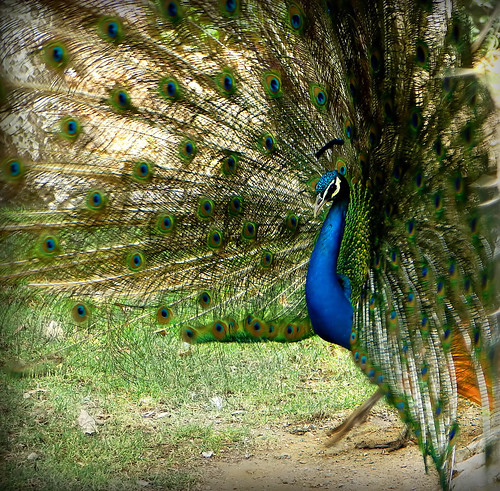
Sexual selection is different. The sex which puts the most effort into reproduction wants to choose the mates with the best genes. So they look for indicators of genetic fitness. Deer-chicks look for the most impressive antlers in the deer-dudes. Pea-hens look for the most impressive tail. BoP-babes look for the... I dunno. Creepiest sodding dance or display of kleptomania that the males can manage it seems. As a result, the sex (usually males) which puts in the least effort get sex more often if they have indicators of their fitness. Take the peacock tail again; over the generations the peacocks with the biggest tails pass down their genes to the next generation whilst the peahens pass down their appreciation of bigger and bigger tails. The trait gets exaggerated alongside the admiration of it. In this way, traits which don't help survival generally exist in all species because they aid in procuring happyfuntime. Miller suggested that 'culture' in humans was as simple as this; and here is why:
 | ||
| Damn right, shirt. |
To study the evolution of any cultural trait, you have to explain the genetic progression through natural and sexual selection of the cognitive abilities of humans to produce those traits. We're not talking particular genres of music, art or literature; we're talking of the concepts in general. The sub-types are heavily informed by external factors. The most effective method for collecting good data is to work out the fitness benefits of particular traits to the individuals who displayed them. Catchpole (e.g. 1995) not only has a really cool second name, but studied a lot of bird species. He has tested hypothesis on the production of birdsong by comparing individual variation in songs with survival and reproduction rates. Whilst natural selection is generally a species-wide change; sexual selection tends to force mass individual variation in behaviour in a sort of witty sexual oneupmanship. Studying these phenomenon in humans has proven to be difficult. Anthropologists (who study humans) have had a lot more experience of the economic, ritualistic and survival characteristics of a group than of their reproductive strategies. After all, wouldn't you be just a little secretive and misleading if a social scientist wanted to include you in a mass study of intimate courtship stuff? As a result, we know a lot more about natural selection in humans than sexual selection; which has kind of fallen off the wagon as far as theories go.
So if the courtship model is to be believed; female humans should select for indicators of fetility, healthy, parenting abilities and 'gene quality' in general, in their mates. Just like in every species, indicators that are too easy or lack in any cost would be too easy to fake by weaker mates. Just like the peacock's tail, the cost in terms of energy, risk and/or long term survivability should be high... So.... purchasing a fast and expensive sports car? Many cues over a whole buch of species are now known to be simple indicators. Lek species dance right out in the open, in the same place, daily. That sort of pattern would make it really easy for a lion, or whatever the hell hunt leks, to grab them in large quanitity. Another pretty cool cue is in some birds who fight like maniacs for a central position in the mating fields. These often occur on islands free of predators, so the fighting abilities of the birdies are in themselves indicators of fitness as opposed to a naturally selected self-defense ability. As sexually selected traits usually impair survival ability, they are usually fairly easy to tell apart.
There is no reason to suggest humans would be any different. Our mate choice strategies should be focussed on sexual indicators that hint at genetic fitness. The most obvious examples of human culture; art, literature, music, creative use of language; they don't have any obvious survival benefit for actions so costly in energy and time. From someone looking from the perspective of indicators; those sorts of wastful displays are exactly what would be expected.
So long as courtship displays act as 'handicaps' to the individual making them, the fine details don't really matter. The peacock's tail needs to be large, heavy and costly to produce to act as an indicator of fitness (crap peacocks couldn't put in that effort). The colours and patterns don't seem to matter so much to peahens. I'm pretty sure Stephen Fry mentioned that Peahens found the spots on the tails the main attractive feature though. Perhaps they take a lot of effort to grow; or he is just wrong.
 |
| *SWABUMF!* Come to me, woman. |
Fisher (1930) came up with the runaway model that I sort of mentioned above. He believed that an attraction to an indicator would become genetically correlated with that indicator. Both the attraction and the trait would get caught up in a positive feedback loop, exaggerating both sides of the same coin. I.e. "Ooh, I like your quite big beard" Next generation: "Ooh I REALLY like your huge beard." As the indicators need only be costly to the individual showing them, they are very hard to predict even between different groups of the same species. For this reason exaggerated traits and attractions to them are likely to be different so long as the groups are seperate. This is a sensible explanation for the huge variation in attractive features across human societies.
According to Miller, and contrary to a suprising number of theorists, culture does not appear as a side-effect of humans having a large brain for their body size. Culture comes in plenty of different formats that involve entirely different processes, and the only obvious underlying features are too close to those of fitness indicators to be ignored. They are self-expressive, they involve costly amounts of time and energy, they don't have any feasible survival benefits, they are unique to humans, they show vast individual variation (as we'd expect from sexual, rather than natural selected traits. The whole point of indicators is to highlight these differences after all). They all involve some or all of health, creativity and or intelligence; and most importantly, they are designed to appeal to other humans. Miller had damn good grounding for creating his courtship model I reckon.
The model has an explaination for why areas of culture have so many traditional and expected basic components. Trying to compare between two courtship displays would be difficult if they didn't share any common features. By following rules such as rhythm and tonality in music, you give listeners an easier time of noticing superior end-products. Grammar and pronunciation could be mediated in large part by this drive to seperate who is good at language and who fails. The following for these sorts of rules might explain why atonal music and abstract artwork remain underdogs in their respective fields. They make it difficult for observers to tell if the producers are any good. Catchpole (birdie man) did a lot of work looking into the combination of basic elements of birdsong into new and interesting patterns. By capturing the attention of potential mates with novel displays, the creativity of the displayer shines. New stories with old words... The summary is that comparable basics allow outsiders to check for quality, whilst novel combinations can still be created to express creativity.
It's really worth noting that sexually-selected behaviours don't have to feel sexy to the 'users'. Miller points out that the behaviours themselves don't tend to come with the instrinsic understanding that that is what they are for. Miller gives the example of the human male beard. Although it is most certainly around through female mate choice, it does not actually contain this knowledge. It just grows and shows the male as having reached sexual maturity. Psychological adaptations are generally no different; switch back to the rock musician I mentioned at the beginning of the post. The impulse to create and perform this stuff begins upon puberty in most cases, and production increases and decreases over time in line with female fertility (we'll see later that pretty much all behavioural indicators follow this pattern). The musician doesn't necessarily notice the reason for their sudden inspiration to learn their instrument, and to play it in places were 'single members of the opposite sex congregate'. Sexual selection doesn't reduce culture to a basic horny drive, any more than natural selection reduces skill-learning to pure survival.
 |
| To keep this blog family friendly, the hoe has been airbrushed out. |
There are few better pieces of evidence for the courtship model, than Miller's own study in 1999. The extent of cultural production should depend on the age and sex of the producer if those productions are truly sexual indicators. In most/all other animal species that have had their sexual indicators examined: Their indicators become prominent upon sexual maturity, peak at young adulthood when sexual selection is most ferocious, and decline as either parenting becomes more costly or female fertility declines. Perhaps obviously, males should show the indicators way more often than females (who should have little need to display in the same way as men.)
Miller looked at 2000 jazz albums, 3400 modern paintings and 3000 english-language books. He found the ages and genders of the producers when they created the work and plotted it on a graph. Let me show you the graph. Compare it to the pattern of sexual indicators I just spoke about.
 |
| They all follow the exact pattern expected of sexual indicators. Who knew that males produced so much more 'art' than females? I would've thought it was the other way round. |
It is very important to make this point. Even although human males have massive incentive to display their fitness indicators like f***; females are obviously not the equivalent of peahens. They don't bugger about wearing grey loose clothing and avoid producing any creative work, instead choosing just to off-handedly pick the most impressive male. Given roughly equal numbers of each gender in most populations, they would want to appear attractive so as to avoid repelling any courtship attempts. The costs of male sexual harassment (both great and small scale) has likely pushed females to a very different strategy than that of males. I reckon it is sensible to suggest (and is probably true) that females would be more likely to target certain prospective mates rather than 'broadcast their fertility and attractiveness indiscriminately' like males. By keeping their courtship displays limited to individual males the, often uncomfortable, flirting attempts and perceived leers of men in general would be reduced. This is so obviously the way that females generally do things; if you think of the famous dimorphism between men and women in our society. Men throw themselves out there in an attempt to find a partner, whilst women are much more likely to discretely put all their efforts into one particular person.
....Gotta say; reading an article I agree with, that explains in a sensible fashion why women are the way they are is quite depressing! How do you attract women if you lack in creativity? Lies and luck. Sadface from Radjamaki.
Females, according to Miller, would be expected to 'court' their partner after a sexual relationship has formed, and even after children have been... erm.. birthed. Their courtship designed to attract his continued attention and investment towards her and their family. The genders have such vastly different motivational systems but have equal capacity for cultural production. It is just that males have incentive to broadcast their productions (enter them into the public domain) whilst females find advantage in keeping it secret and specifically for that special person. Not to be ignored are the values of willpower and morality. Men who show no willpower will gaze lustfully at the slightest glimpse of cleavage. Women who show no morality will ruthlessly tease men they have no intention of getting closer to, just for their own self-esteem and satisfaction. Those belong to a different post, though.
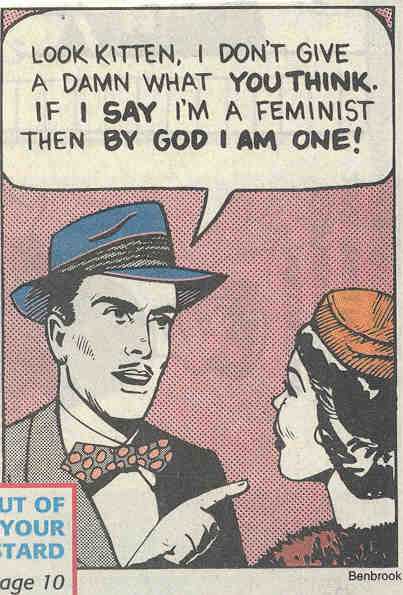
One last point. The feminist viewpoint of the courtship model suggests that the results are actually reflective of a society that has been, essentially, a partriach for the extent of history. Were that so, feminists would have to explain why cultural displays in humans match the display patterns of sexually selected traits in other species (who do not have any history of male dominance). Personally, I think the best way they could explain it is by saying "Whoops, we were wrong."
Gives me a lot to think about. I hope you find the whole argument pretty interesting :).
P.s. the title comes from a little tidbit I didn't include. A couple of researchers found the homicide rates in certain countries to follow the same patterns as other sexually selected cultural traits in humans; suggesting that they may be exaggerated displays of... I dunno. Masculine aggression and risk taking or something. Anyway, Miller wrote a fantastic sentence in his work: "While homicide rate typically peaks in the early 20s, the later peak for jazz album production suggests that it takes longer to learn to play good music than to kill someone."
Only a psychologist...
....Gotta say; reading an article I agree with, that explains in a sensible fashion why women are the way they are is quite depressing! How do you attract women if you lack in creativity? Lies and luck. Sadface from Radjamaki.
 |
| Apply Within. |
Females, according to Miller, would be expected to 'court' their partner after a sexual relationship has formed, and even after children have been... erm.. birthed. Their courtship designed to attract his continued attention and investment towards her and their family. The genders have such vastly different motivational systems but have equal capacity for cultural production. It is just that males have incentive to broadcast their productions (enter them into the public domain) whilst females find advantage in keeping it secret and specifically for that special person. Not to be ignored are the values of willpower and morality. Men who show no willpower will gaze lustfully at the slightest glimpse of cleavage. Women who show no morality will ruthlessly tease men they have no intention of getting closer to, just for their own self-esteem and satisfaction. Those belong to a different post, though.
One last point. The feminist viewpoint of the courtship model suggests that the results are actually reflective of a society that has been, essentially, a partriach for the extent of history. Were that so, feminists would have to explain why cultural displays in humans match the display patterns of sexually selected traits in other species (who do not have any history of male dominance). Personally, I think the best way they could explain it is by saying "Whoops, we were wrong."
 |
| Sweet Hat |
P.s. the title comes from a little tidbit I didn't include. A couple of researchers found the homicide rates in certain countries to follow the same patterns as other sexually selected cultural traits in humans; suggesting that they may be exaggerated displays of... I dunno. Masculine aggression and risk taking or something. Anyway, Miller wrote a fantastic sentence in his work: "While homicide rate typically peaks in the early 20s, the later peak for jazz album production suggests that it takes longer to learn to play good music than to kill someone."
Only a psychologist...


